Owner-operated · Licensed & insured · CPC1459857

License # CPC1459857
Free consultation
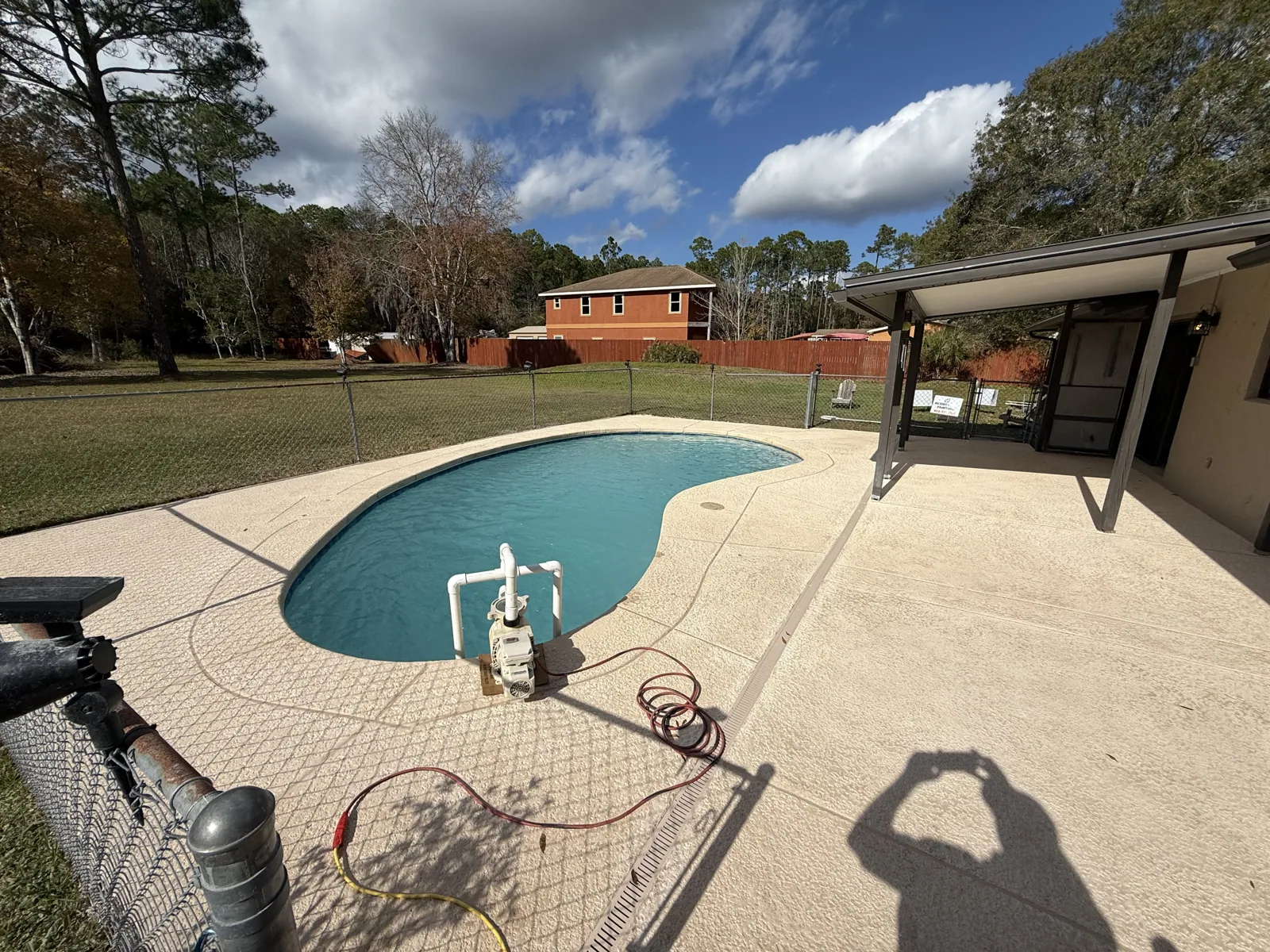
Most people who call us have already narrowed it down to two choices, and they want to know which one is the right call for their yard. Here is how concrete and fiberglass pools actually differ in Northeast Florida, and what each one asks of you once the crew has gone home.
A fiberglass pool arrives as one finished shell and goes in fast. A concrete pool is formed on site, so it can be any shape and any size you can fit and permit. Neither is better in the abstract. The right one depends on the shape you want, how soon you want to swim, your soil and water table, and how you would rather spend money over the next twenty years — a larger amount now, or smaller amounts spread across resurfacing cycles.
Both are built to the same standard here, and both are covered by the same licence, CPC1459857.
Effectively, yes. Gunite and shotcrete are two ways of placing concrete, not two different kinds of pool. Both spray a concrete mix through a hose against a steel rebar cage. Gunite mixes the water in at the nozzle; shotcrete arrives already wet. Poured concrete is a third method.
So when you read “gunite pool vs fiberglass”, the real comparison is concrete versus fiberglass. The placement method is a construction decision made per project, on the site conditions and the design — the same way a builder decides on footing depth. It is not a menu item, and a builder who sells you one method as a brand is selling you the wrong thing.
We use the concrete method each project calls for. What you are choosing between is a shell formed on site and a shell delivered finished.
The hole is excavated, plumbing and steel go in, and the concrete shell is placed against the rebar. It cures, then it is tiled, coped and finished — plaster, quartz or a pebble aggregate. Because the shell is formed in place, the design is not constrained by a mould: vanishing edges, tanning ledges, odd angles to fit a lot line, benches and spas built into the same structure.
The shell is manufactured off site as a single piece with the finish already bonded to it, then delivered and set into the excavation. Plumbing is connected, the shell is backfilled and levelled, and the deck is poured around it. The finish you see on delivery day is the finish.

More on the range we carry: fiberglass pool installation.
Fiberglass is the faster build, usually by a wide margin, because the longest step — forming and curing a shell — has already happened in a factory. Once the shell is set and connected, most of what remains is decking and equipment.
Concrete takes longer because curing and finishing cannot be rushed without paying for it later. In Northeast Florida the summer storm pattern also matters: excavation and concrete work are weather-dependent in a way that setting a shell is not.
If a date matters to you — a graduation, a summer, a family visit — say so at the first conversation. It changes the recommendation more than most people expect.
This is the clearest difference between the two.
If you are weighing designs, our pool designs and pricing page shows what each approach looks like built.
A fiberglass shell’s gel coat is non-porous, so it holds less algae and generally asks less of your chemistry. There is no interior finish to replace on a resurfacing cycle.
A concrete shell is porous. Its plaster, quartz or pebble interior is a wear surface, and it is resurfaced periodically — how often depends on water chemistry, use and the finish chosen. That is not a defect; it is how the system is designed, and it is also the moment a concrete pool can be changed. A resurfacing is when a dated finish becomes a current one. We cover this in detail in our guide to pool resurfacing.
Salt systems work with both. Concrete needs the chemistry watched a little more closely.
Three local conditions do real work in this decision.
Water table. Much of Clay County sits on sand with a high water table. Both pool types are built here routinely, but a fiberglass shell is buoyant and an empty one can move if it is drained carelessly or if groundwater rises around it. Draining a fiberglass pool is not a homeowner job. Concrete shells are heavier and less sensitive to this, though the same caution applies.
Storms. Neither shell type is meaningfully more vulnerable to wind. What matters after a storm is debris and the electrical equipment, not the pool.
Year-round use. We do not get freeze-thaw cycles that punish concrete the way they do further north, which removes one of the standard national arguments against it. A concrete pool built here is not fighting the climate.
Comparing a delivered price on one and a starting price on the other is how people end up disappointed, so compare the same things: shell, decking, equipment, screen enclosure if you want one, and the finish.
Fiberglass generally has a lower entry point and a narrower range, because the shell is a known product. Concrete has a wider range, because the design drives the number.
Current figures for both live on pool designs and pricing. For a fuller breakdown of what sits inside each number, see our inground pool cost guide and the fiberglass pool cost guide.
If a screen enclosure is anywhere in your plans, decide before the pool is finished, not after. The footers for an enclosure are set into the deck, and adding them later means cutting and repairing finished concrete you have already paid for. This is true for concrete and fiberglass alike, and it is the single most common avoidable cost we see.
More on that: pool screen enclosures.
We walk the yard, look at access, soil and where the equipment can live, and then show you the same design both ways where both are genuinely possible. Sometimes access rules out fiberglass before anything else is discussed. Sometimes a shape you have set your heart on only exists in concrete. More often than not, both work and the choice comes down to timeline and how you want to spend money over time.
We build both, so we have no reason to steer you.
We will look at your yard, tell you plainly which options are realistic on it, and put real numbers against each. Serving Clay and surrounding counties.
Call (904) 465-5621 or request a quote. Licence CPC1459857.
Yes. Gunite is one of the methods used to place concrete against the steel cage that forms the shell, alongside shotcrete and poured concrete. The finished product is a concrete pool. The placement method is chosen per project on site conditions and design.
Both last decades when they are built and maintained properly. They age differently: a concrete pool’s interior finish is a wear surface that is resurfaced periodically, while a fiberglass shell’s bonded gel coat is not resurfaced but also cannot be refinished in place the same way.
Fiberglass usually has the lower entry point and a narrower price range. Concrete has a wider range because the design drives the cost. Current figures are on our pool designs and pricing page, and the comparison only means something if both quotes cover the same scope.
No. Fiberglass shells come in the shapes the manufacturer moulds, and the shell has to reach your back yard by truck and crane. Access is often the deciding factor. Concrete has no practical shape limit.
No. Fiberglass pools are installed here routinely. It does mean an empty fiberglass shell can shift if it is drained without managing groundwater, so draining one is a job for the builder rather than the homeowner.
Now, if you want one at all. Enclosure footers are set into the deck. Adding them afterwards means cutting and repairing finished concrete, on either pool type.