Owner-operated · Licensed & insured · CPC1459857

License # CPC1459857
Free consultation
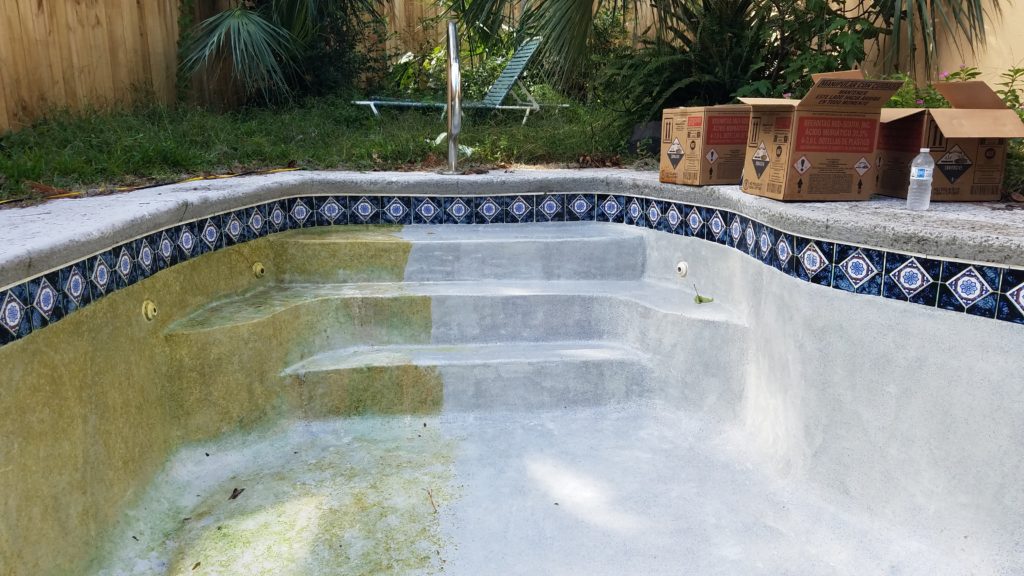
Florida sun, mineral-heavy fill water, and long swim seasons take a toll on a pool's finish. Over time, calcium scale creeps along your waterline. Stains settle into the plaster. Sometimes algae digs in and simply will not brush out. When ordinary cleaning stops working, a pool acid wash often brings the surface back to life. At Southern Pools of Florida (CPC1459857), we build and remodel gunite and fiberglass pools across Clay, St. Johns, Duval, and Nassau counties. Now we also offer drain & clean — a one-time restorative service, not a maintenance plan. Owners Matt Georges and Josh Lowell handle this work personally, because draining a pool in Northeast Florida carries real risk. Below, we explain what the process does, when it makes sense, and why it belongs in expert hands.
A pool acid wash is a deep restoration that drains the pool, then strips a thin top layer of plaster or gunite with a diluted acid solution. As a result, embedded stains, calcium scale, and algae come off with that layer, and the surface looks new again.
The work moves through clear stages. First, we drain the water completely. Next, we brush and rinse the shell. Then we apply the wash in sections and neutralize the runoff with soda ash. Finally, we refill the pool and balance the water. Because the process removes a sliver of the surface, it suits concrete, gunite, and plaster-finished pools. It does not suit fiberglass, however; acid would damage that gel-coat surface. Therefore, fiberglass pools need a different approach, and our team can advise on it.
One point matters above all. A drain & clean is restorative work — essentially minor remodeling. In other words, it is not a recurring cleaning service. We do it once, do it right, and protect your finish for years.
Your pool likely needs a drain and clean when stains, scale, or algae no longer respond to normal brushing and chemistry. That is, the surface itself has become the problem, not the water.
A few signs point clearly to a wash:
Most plaster pools benefit roughly every five to seven years. However, washing too often thins the plaster and shortens its life. For that reason, we assess each pool first and recommend a wash only when the surface truly calls for it. According to industry guidance on pool surface care, proper water balance after the wash also protects the finish from the next round of staining.
Not necessarily. A screen enclosure keeps leaves and debris out, but it does nothing to stop calcium scale — and scale is the number-one reason Northeast Florida pools need a drain & clean.
Here is why that surprises so many homeowners. A screen does block windblown debris, so you will see fewer organic stains and less surface algae. So far, so good. However, calcium does not blow in on the wind. Instead, it comes from the water itself. Our local fill water often arrives already high in calcium, straight from the tap.
Then the Florida heat takes over. Water evaporates fast here, yet the minerals stay behind. Consequently, every time you top off the pool to replace evaporation, the calcium concentration climbs higher. A screen enclosure cannot stop that cycle, because it neither softens your water nor halts evaporation. Rain makes matters worse, too; after each storm the pH rises, and calcium drops out of the water onto your surfaces. Above the waterline, that leaves the chalky "bathtub ring" so many owners recognize.
In short, your screen protects against what falls into the pool. It does nothing about what builds up in the water. Therefore, a well-kept, fully enclosed pool in Ponte Vedra or Fleming Island can still develop scaled, dull plaster after a few summers — and a drain & clean is the only real reset.
Draining a pool here is risky because Northeast Florida sits on a high water table, and the groundwater can lift an empty pool right out of the ground.
Here is why. A full pool is heavy, and that weight holds the shell down against the water pressure below it. Once you drain it, however, that counterweight disappears. Meanwhile, groundwater keeps pushing upward. When that pressure wins, the pool can crack, bulge, or "pop" — floating up like a boat. Repairs after a pop are brutal; often the only real fix is demolition and a rebuild.
This risk climbs during our rainy season. From June through September especially, Northeast Florida's high water table rises, sometimes to within a foot or two of the surface. Near the St. Johns River corridor, across low-lying Duval neighborhoods, and along the Nassau County coast, saturated soil is common.
Because of all this, we never just pull the plug. First, we read the groundwater conditions and pick the right timing. Next, we manage the hydrostatic relief valves built into the pool floor. We also direct the drained water well away from the shell. As licensed contractors who build these structures from the ground up, Matt and Josh know exactly how a gunite shell behaves under pressure. That knowledge is the difference between a clean restoration and a five-figure disaster.
A drain and clean restores a sound surface, while resurfacing replaces a worn-out one. Choosing correctly saves you real money.
If your plaster is basically solid but stained, scaled, or faded, an acid wash usually buys you several more years. On the other hand, if the plaster is thin, cracked, hollow, or already acid-washed several times, you have reached resurfacing territory. In that case, a wash only delays the inevitable — and acid on a cracked surface can even make things worse.
We will tell you honestly which camp your pool falls into. Because our remodeling team handles resurfacing, new tile, and modern finishes too, we have no reason to push a wash that will not last. Instead, we recommend the option that genuinely fits your pool and your budget.
Ready to bring your pool's finish back to life? At Southern Pools of Florida, drain & clean is restorative work we now offer across Green Cove Springs, Orange Park, Fleming Island, Ponte Vedra, St. Augustine, Jacksonville, and Fernandina Beach. Because we are owner-operated, Matt and Josh personally evaluate your pool, manage the drain safely, and stand behind the result. We do not cut corners, and we do not chase the lowest price — we protect your investment instead. Call us at 904-465-5621 or request your free consultation. We will look at your surface, explain your options clearly, and recommend a wash only when it is truly the right call.
Is a drain and clean the same as resurfacing? No. A drain and clean strips a thin layer of existing plaster to remove stains and scale, while resurfacing applies a brand-new finish. A wash restores a sound surface; resurfacing replaces a failing one. Our team helps you decide which your pool needs.
Does a screen enclosure stop calcium buildup? No. A screen blocks leaves and debris, but calcium comes from your fill water and concentrates as water evaporates. Enclosed pools across Northeast Florida still develop calcium scale and still benefit from a drain & clean.
How often should a pool be acid washed? Most plaster and gunite pools benefit roughly every five to seven years. However, washing too often thins the plaster and shortens its lifespan, so we recommend it only after inspecting the surface first.
Can you acid wash a fiberglass pool? No. Acid washing strips surface material, which damages a fiberglass gel coat. Fiberglass pools need a different approach, and our team can guide fiberglass owners toward the right solution.
Is it safe to drain my own pool in Florida? We strongly advise against it. Northeast Florida's high water table can lift a drained pool out of the ground, causing structural damage that often requires a full rebuild. A licensed contractor manages that groundwater risk safely.
For more questions about our construction and remodeling work, visit our FAQ page.