Owner-operated · Licensed & insured · CPC1459857

License # CPC1459857
Free consultation
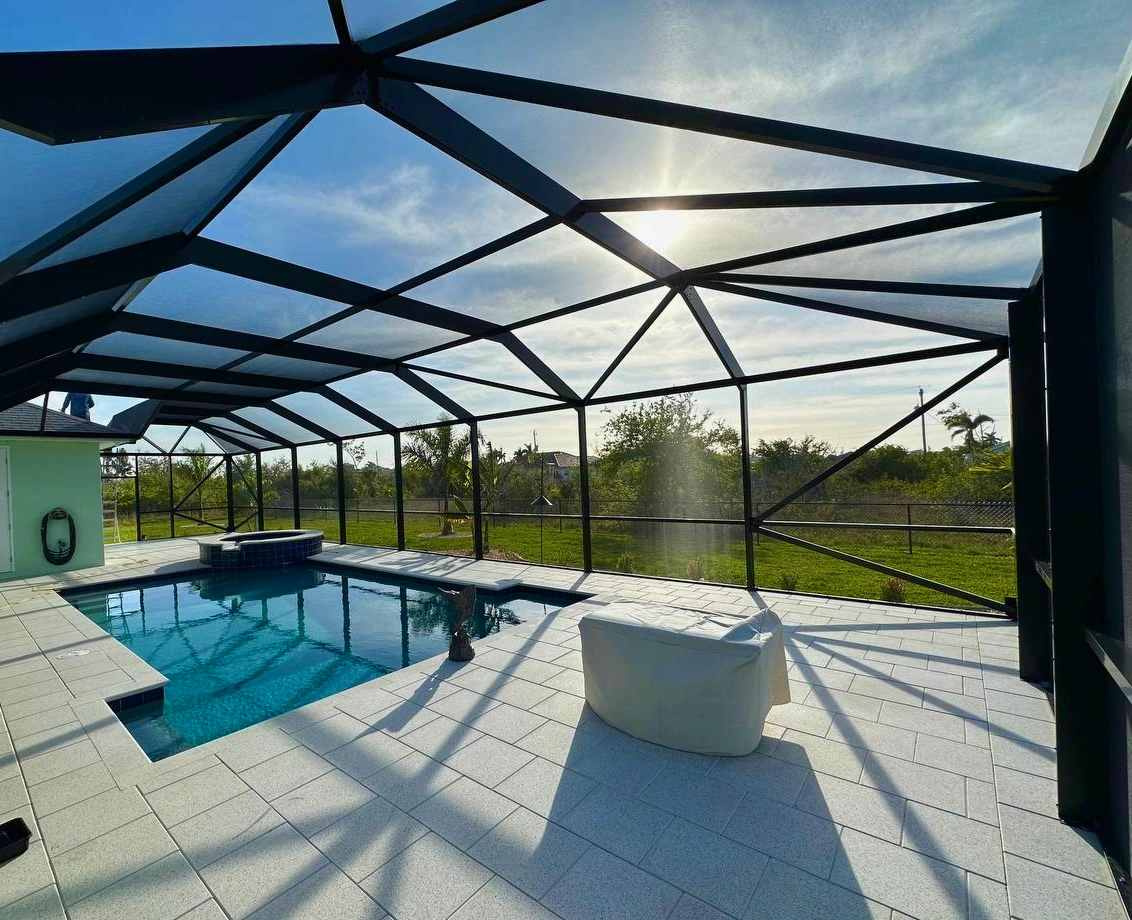
Around here, most people call it a pool cage. Builders and permit offices call it a pool screen enclosure. They’re the same thing — an aluminum frame and screen structure that wraps your pool and deck, keeping bugs, leaves and direct sun out of the space your family actually uses.
Southern Pools of Florida builds custom pool screen enclosures across Clay County, St. Johns County, Duval County and Nassau County — Green Cove Springs, Fleming Island, Orange Park, Middleburg, Jacksonville, Ponte Vedra, St. Augustine and Fernandina Beach. Matt and Josh are owner-operators (license CPC1459857), and they’re on every project from design through final inspection.
Below: what a pool cage costs, the styles you’ll see around here, the screen options that actually matter in this part of Florida, how permitting works — and an honest look at whether an enclosure is right for your yard, including when we’d tell you to skip it.
A quality screen enclosure for a standard residential pool in Northeast Florida generally runs $8,000 to $20,000 installed, depending on size, roof style and screen specification. Larger enclosures, high-peak roofs and premium screen or framing packages run above that range.
Rescreening — which you’ll do eventually, not immediately — typically runs $1,500 to $5,000 depending on square footage.
Footprint. The single biggest factor. Enclosure pricing is largely a function of square footage of frame and screen, so the deck area you enclose matters more than the pool itself.
Roof style and height. A low-profile or mansard roof uses less material and less structural aluminum than a high-peak gable or a dome. Height drives cost quickly — both in material and in the engineering required to meet wind load.
Screen specification. Standard mesh is the cheapest option and the wrong one for a lot of properties around here. No-see-um, pet-resistant and solar screens all cost more, and the upgrade is usually worth it on the lower panels only.
Framing gauge and colour. Heavier gauge for larger spans. Colour is mostly aesthetic, though it affects how visible the frame is against your view.
Doors, kickplates and gutter integration. Number of entry doors, kickplate height, and whether the enclosure ties into existing gutters and roofline.
Existing deck condition. On a retro-fit, the enclosure has to anchor into sound concrete. If the deck needs work first, that’s a separate line item.
Engineering and permitting. Every enclosure in Florida needs engineered drawings and a permit. That’s included in a proper quote — if a bid looks unusually low, check whether it is.
If you’re building a new pool, the most cost-effective moment to add an enclosure is during construction, not after — and there’s a finish-protection reason for that too, covered further down.
There’s no single right style — it depends on your roofline, your lot and your budget. Here’s what you’ll actually encounter around here, so you know the vocabulary before anyone quotes you.
Mansard is the most common. Vertical side walls rise to a sloped transition, then a flat top. It’s the most efficient use of material, keeps overall height down, and suits most standard residential lots. Drive through Fleming Island or Orange Park and most of what you see is mansard.
Gable, or high-peak, has a peaked roof like the gable end of a house. Much more open overhead, and the extra height suits larger pools or homes where a low roofline would look cramped against a two-storey elevation. More material and more engineering, so it costs more.
Dome uses a curved profile with substantial overhead clearance. Striking on the right house, and typically the most expensive.
Screen rooms and low-profile enclosures use a flat or shallow-pitch roof attached to the home, often covering a patio or lanai as much as the pool. Ask about picture-window framing here — it removes the horizontal cross-members at eye level, so the view out is far less interrupted.
We’ll walk your lot and tell you which of these actually makes sense for your house before anyone starts drawing.
This is where the biggest avoidable mistake happens, so it’s worth reading properly.
No-see-ums — biting midges — are under 3mm long, feed mainly at dawn and dusk, and their bites leave welts that linger for days. They breed in the marsh, tidal areas and damp soil that define much of the landscape around Green Cove Springs, Middleburg, Ponte Vedra and coastal Nassau County.
Their bodies pass straight through standard enclosure screen.
If biting midges are a concern on your property — and if you’re near water or marsh, they will be — you need to specifically request 20-mesh or finer “no-see-um” screen on the lower panels where these insects are most active. This is a decision made at design time and again whenever you rescreen. It is not something you can retrofit cheaply.
Pet-resistant screen. Heavier weave that stands up to dogs and cats. Worth it on the lower sections near doors if you have animals with opinions.
Solar and privacy screen. Cuts more UV and reduces visibility into the space, at the cost of some airflow and outward view.
Standard 18x14. Fine for the upper sections on most properties — a common approach is standard above, no-see-um below, which controls cost without leaving the gap where it matters.
Aluminum in a range of gauges and colours. In our coastal humidity the framing needs occasional inspection and touch-up to prevent corrosion — particularly in Nassau County and the coastal St. Johns areas.
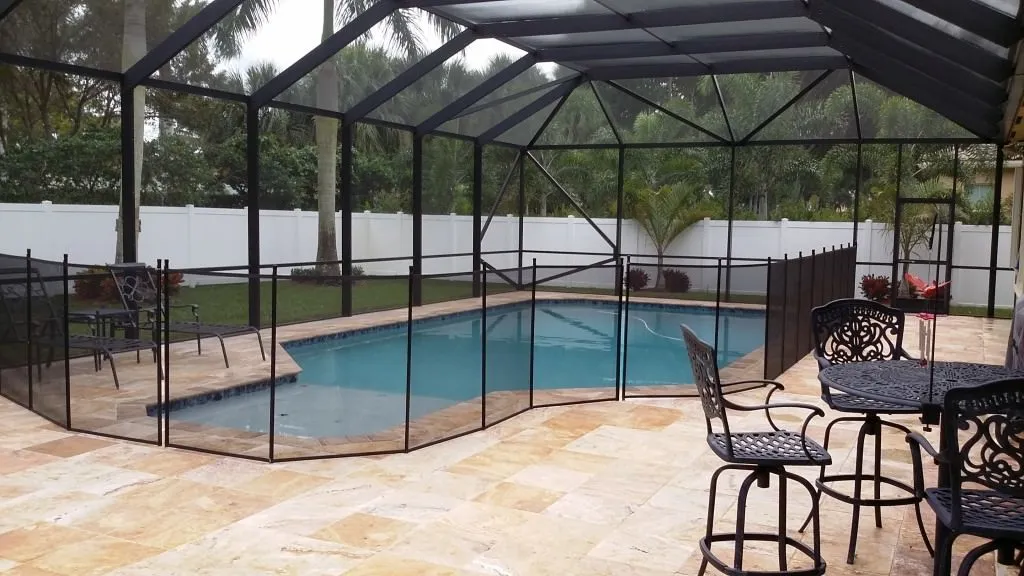
Every pool screen enclosure in Florida requires a permit and engineered drawings. We pull the permit and handle the inspections — that’s part of the job, not something we hand back to you.
Wind load is the governing constraint. The Florida Building Code sets wind-load requirements that vary by location, and Northeast Florida’s differ meaningfully from South Florida’s. Your enclosure’s framing gauge, span and anchoring are all engineered to meet the code for your specific address — which is why two enclosures that look identical can be priced very differently, and why an unusually cheap bid is worth scrutinising. Ask any contractor whether engineered drawings and permit fees are included in the number they’ve quoted you.
HOA approval is separate from the building permit, and in many Clay County and St. Johns County communities it’s required before work starts. Setbacks, frame colour and roof style are all things an HOA may have views on. Check early — it’s the most common cause of delay.
This surprises a lot of homeowners, and it matters.
Most enclosures in Northeast Florida are attached to the house. In that configuration, the enclosure alone does not satisfy the legal barrier requirement. A separate compliant barrier is still needed — a perimeter fence with a self-latching gate, a power safety cover, or door alarms on any home entry point that gives access to the pool area.
A freestanding enclosure not attached to the home can satisfy the requirement on its own, but that’s the less common configuration. Always confirm your specific setup with your contractor and the local building department during permitting.
This is the part most homeowners don’t know to ask about, and it’s the reason sequencing matters more than people expect.
On our builds, the screen enclosure is erected before the pool is plastered.
Putting up an enclosure means crews, ladders, aluminum sections and fasteners moving around the pool shell. Do that after the interior finish has gone in and you’re risking chips, scratches and staining on a brand-new plaster surface — the single most visible, most expensive-to-repair part of the pool. Sequencing the enclosure first means the finish goes into a protected, finished space and never takes that abuse.
It also means the deck is poured with the enclosure’s anchor points already planned, rather than drilled in afterwards.
The practical implication: if you think you might ever want a cage, tell us at design time even if you’re not sure you’ll do it now. We can plan the deck and anchor layout around it. Retro-fitting later is entirely feasible — it’s a normal part of our pool remodeling work — but doing it in the right order during the original new pool construction is cheaper, cleaner, and safer for the finish.
We said honest, so here it is — including the parts that don’t help us.
Insect and debris control. It keeps the large majority of flying insects, leaves, pollen and airborne debris out of the pool and deck. Less skimming, lower chemical consumption, slower algae growth. On a heavily wooded lot in Middleburg or Fleming Island, the maintenance reduction alone can justify it.
UV protection and evening comfort. Screens cut UV exposure meaningfully, which matters when your family is poolside for hours in a Florida summer. It also buffers afternoon showers and makes evening use far more comfortable by cutting mosquito and no-see-um exposure at dusk, when both peak.
Reduced evaporation. Florida heat pulls water out of an open pool fast. An enclosure slows that, holding water level and reducing top-up chemistry.
Resale. In most Northeast Florida neighbourhoods a screened pool is simply the expected configuration. An unscreened pool in a street of screened ones reads as a disadvantage to buyers, not a feature.
The lovebug thing. Twice a year, spring and fall, lovebugs arrive in enormous numbers. They don’t bite, but they coat pool surfaces with a residue that affects water chemistry if left. Frogs, snakes and the occasional wandering visitor are also legitimate poolside guests here — something transplants rarely anticipate and locals treat as a fact of life.
Upfront cost. $8,000–$20,000 is a meaningful addition to a pool budget that’s already significant.
Ongoing maintenance. Screens don’t last forever. Expect to rescreen every 10 to 15 years under normal conditions — sooner after storm damage — at $1,500 to $5,000. The framing needs periodic inspection in our humidity.
Cooler water. Filtering direct sun keeps the water several degrees cooler than an open pool in the same yard. Irrelevant most of the year; noticeable in our short winters, especially without a heater.
It frames your view. An enclosure defines your outdoor footprint. If you back onto a pond, preserve or golf course, you’re putting aluminum and mesh between you and that. Plenty of people genuinely don’t mind. Others find it a hard trade. Think it through before committing.
It won’t stop no-see-ums unless you specify the right screen. Covered above, and worth repeating because it’s decided at install, not after.
That last one matters. We’d rather build you a better pool without an enclosure than a compromised pool with one.
This comes up constantly from people moving down from the north, so it’s worth a direct answer.
An automatic pool cover slides over the water at the push of a button. It’s excellent for safety, debris and evaporation when the pool isn’t in use, it looks clean, and in most configurations it qualifies as a safety barrier under Florida law.
But it doesn’t enclose the space around the pool. When the cover is retracted and your family is actually in the water, you’re fully exposed — mosquitoes, no-see-ums, lovebugs, debris, all of it. A screen enclosure protects the people, not just the water surface.
They’re not always competing; some homeowners do both. But if what you want is an outdoor living space you can use comfortably at dusk on a Northeast Florida summer evening, a cover alone won’t get you there. A cage will.
You don’t need a new pool to get an enclosure. Retro-fits are a common part of our remodeling work.
The variables are your existing deck configuration, available attachment points on the home, and setback requirements. In most cases it’s straightforward. Where it gets complicated is when the existing deck isn’t sound enough to anchor into, or when setbacks limit the footprint — both things we can assess on a site visit.
Already have a cage that’s seen better days? Rescreening and frame repair are usually far cheaper than replacement.
Green Cove Springs · Fleming Island · Orange Park · Middleburg · Jacksonville · St. Johns · Ponte Vedra · St. Augustine · Yulee · Fernandina Beach — and across Clay, Duval, St. Johns and Nassau Counties.
The screen enclosure question comes up on every project we design. There’s no single right answer — it depends on your lot, your family and how you’ll actually use the space.
Matt and Josh are on every project from design through completion, so this conversation happens directly with the people building your pool, not a salesperson. If you’re still costing out the build itself, our pool packages and pricing and our fiberglass pool cost guide are good places to start.
Call (904) 465-5621 or request a free consultation for an honest assessment of your specific property.
A quality screen enclosure for a standard residential pool in Northeast Florida generally runs $8,000 to $20,000 installed. Price is driven mainly by enclosed square footage, roof style and height, and screen specification. Larger enclosures, high-peak or dome roofs, and premium screen packages run higher. Rescreening later typically costs $1,500 to $5,000.
Nothing — they’re two names for the same structure. “Pool cage” is the common conversational term in Florida; “pool screen enclosure” is what you’ll see on permits, engineering drawings and contractor quotes.
Yes. Every pool enclosure requires a permit and engineered drawings meeting Florida Building Code wind-load requirements for your specific location. Your contractor should pull the permit and handle inspections. HOA approval, where applicable, is separate and should be started early.
It depends on configuration. A freestanding enclosure not attached to the home can satisfy the requirement on its own. However, most enclosures in Northeast Florida are attached to the house — and in that case a separate compliant barrier is still required: a perimeter fence with self-latching gate, a power safety cover, or door alarms on home entry points providing pool access. Confirm your configuration with your contractor and local building department during permitting.
No. Standard 16-mesh screen won’t stop no-see-ums, which are small enough to pass through typical enclosure material. To block biting midges, specify 20-mesh or finer “no-see-um” screen on the vertical panels. This matters most for properties near marshland, tidal areas or waterways in Clay, Nassau and St. Johns Counties.
With quality aluminum framing and fiberglass or polyester screen, most enclosures last 15 to 20 years before the structure needs significant attention. The screen itself usually needs replacing every 10 to 15 years under normal conditions, though tropical storms and hurricanes can require partial or full rescreening sooner.
Yes. Enclosures can be added to existing pools and are a common part of pool remodeling projects. Existing deck configuration, home attachment points and setback requirements all factor into the design, but in most cases a retro-fit is feasible. Review your setbacks and HOA rules before starting. More answers on our FAQ page.